

A new study reveals why high-performance concrete behaves inconsistently in laboratory tests and how the stochastic placement of granite aggregates can extend structural fatigue life by up to three orders of magnitude.
Concrete is the backbone of our infrastructure, from massive bridges to the foundations of offshore wind turbines. In the real world, these structures rarely fail due to a single overwhelming load; instead, they face the silent threat of material fatigue—the gradual accumulation of microscopic damage over millions of loading cycles. Latest Dr. Petr Miarka’s research study explores how we can influence this fatigue life using something as fundamental as aggregate size and placement.
Static vs. Fatigue: Two Different Worlds
Our experiments on high-performance concrete (HPC) revealed a striking contrast in how the material behaves depending on how it is loaded. Under static or low-cycle loading, the concrete behaved homogeneously and predictably. The test results were consistent, closely following theoretical models and showing very little scatter in strength.
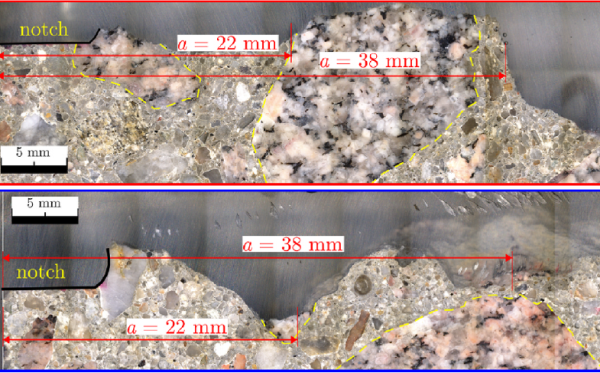
However, as we moved into the realm of high-cycle fatigue (thousands to millions of cycles), this predictability vanished, replaced by massive heterogeneity. We observed two specimens (FAT_01 and FAT_02) tested at the exact same stress level that exhibited a staggering three-order-of-magnitude difference in their lifespan: one failed after just 985 cycles, while the other survived over 1,092,000 cycles.
The Secret is in the „Bridging“ effect
What explains this massive gap in performance? Through optical microscopy and fracture analysis, we found that the key to extreme longevity lies in the meso-structure of the concrete—specifically, the placement of large granite aggregates ($D_{max} = 22$ mm).
When a propagating crack encounters a large, high-quality granite stone, a phenomenon known as aggregate bridging occurs. Instead of cutting straight through, the crack is forced to deviate, go around the stone, or is physically „bridged“ and held together by the aggregate’s interlock with the cement matrix. This creates a „plateau“ in the crack growth rate, effectively acting as a natural brake that significantly delays final failure. A single well-placed piece of aggregate at the crack tip can be the difference between premature failure and a long service life.
Real-World Implications
Our findings suggest that current engineering standards, such as Model Code 2010, may provide overly optimistic expectations for the service life of structures because they do not fully account for these complex internal mechanisms.
By applying advanced frameworks like Paris’ Law to characterize crack growth, our research provides a deeper understanding of how the „inner life“ of concrete governs structural safety. It turns out that concrete is not just a uniform gray mass, but a sophisticated composite where even a single stone, if correctly positioned, can dramatically enhance the resilience of our most critical infrastructure.
This research was a collaborative effort between the Institute of Physics of Materials (Czech Academy of Sciences), Brno University of Technology, University of Seville, and VŠB-Technical University of Ostrav , as part of the OP JAK project ‚Materials and technologies for sustainable development‘ (MATUR): CZ.02.01.01/00/22_008/0004631
Published in Cement and Concrete Composites with Journal Impact Factor: 13.1 and JIF rank 1/95 in Construction and Building Technology; DOI: 10.1016/j.cemconcomp.2025.106394